It’s time. You’ve reserved your ticket, you’ve pulled out your cutest outfit, you’ve re-watched Pose and Legendary just to get in the mood. You’re on your way to your first ever ball.
My first was an anime-themed major ball in Shin-Okubo, hosted by Chise Ninja. It was a lively, explosive affair, full of people I knew from Shinjuku Ni-chome: drag queen friends, queer media enthusiasts, dancers I’d performed alongside in variety shows. I remember standing in the crowded sidelines, open-mouthed with joy. My second, a Christmas mini ball hosted by Koppi Mizrahi, I rocked up, feeling confident and sure of myself… and realized I knew absolutely no one in the room, aside from Koppi herself.

Entering a new community can be a daunting experience, particularly when it’s a protective, marginalized space such as house-ballroom, and when it’s a culture where participants intentionally project self-assured, haughty mannerisms and flaunt incredible vogue and runway skills. If you’re the more nervous and shy type like me, the best thing to do is assemble a gang of friends to visit the ball with you. But if you are unable to find a group — never fear. Ballroom spaces, especially the more casual kiki scene, can be incredibly friendly and welcoming if you can muster the confidence to smile, shake hands, and say, “I’m new here, it’s nice to meet you!”
Thinking back to my entry into ballroom, almost four years ago now, I have compiled the following guide to help a first-timer navigate the intricate world of balls, legends, and vogue battles.
The history and evolution of ballroom as a community of queer Black and Latinx people, as well as how it came to Japan, can be found here.
The Major and Kiki Scenes
Like a two-tier bento box, ballroom can best be understood as two, adjacent and overlapping scenes: the major (also called ‘mainstream’) and kiki (queer African American vernacular English for ‘a casual hangout’) scenes. The major scene, which started first, has developed into a serious, formal, and competitive space, with globally significant events like New York City’s annual Latex Ball gathering crowds of thousands. Major balls expect experienced and well-trained participants (I do not recommend newcomers walk a major), and often feature strict dress codes, panels of high-ranking judges, and cash prizes for category winners, ranging from a few thousand yen to over 10,000 yen. They’re magnificent spectacles to behold.
The kiki scene, meanwhile, developed in the early 2000s to contrast the major scene. Here, balls and functions are more relaxed, casual, and focused on giving the kids experience competing and battling. While some kiki balls can still become somewhat hardcore (such as a “grand kiki ball,” which blends the kiki and mainstream traits), these are great places for ballroom beginners to take a risk and try walking; there is little shame in getting a chop. The kiki scene has a distinct cultural history in ballroom too, as it grew with a special focus on nurturing and protecting the homeless queer youth of New York. Traditionally, kiki balls often feature free food and drink in addition to education and resources for fighting HIV.

Both the major and kiki scenes have their own system of houses, headed by a mother and/or father. Closely related to queer found-families, these houses arose as havens for the aforementioned homeless queer youth fleeing to the US’s cities after being rejected from their original families. Houses today continue to form the soul of ballroom, with many historic houses like LaBeija and Xtravaganza still competing today and maintaining networks that span the globe.
A person may join one major house and one kiki house; someone who is not in a house is referred to as ‘007’ in that scene. Koppi Mizrahi, for example, belongs to the major house of Mizrahi and the kiki house of Pinklady (she is called “Koppi Pinklady” when participating in a kiki ball or function). I myself am also in the major house of Mizrahi, but am 007 in kiki.
An individual leaving their major house is often cause for much shock and gossip; within the kiki scene, however, members tend to change houses “like hats,” as Father Andre Mizrahi once said.
The Structure of a Ball
Regardless of whether you are exploring the major or kiki scene, the first sight that will greet you is pretty standard — a reception counter at the door, a big crowd lining the main room, a panel of three or more judges seated at the far end, and a roughly T-shaped opening in the middle (the runway). A DJ is perched in their booth in some corner of the hall, spinning house music, vogue beats, and a little bit of disco, hip-hop, and R&B. Floating somewhere on the edge of the runway, you’ll see one or two commentators—the people chanting and rapping to the music, keeping the beat for the dancers, and generally hyping the crowd. You might also see the overall organizers—the hosts—hovering nearby, ensuring the ball runs smoothly.
This is the basic set up of just about any ball, excluding strange, outside-of-the-box events where the crowd might vote instead of the judges.
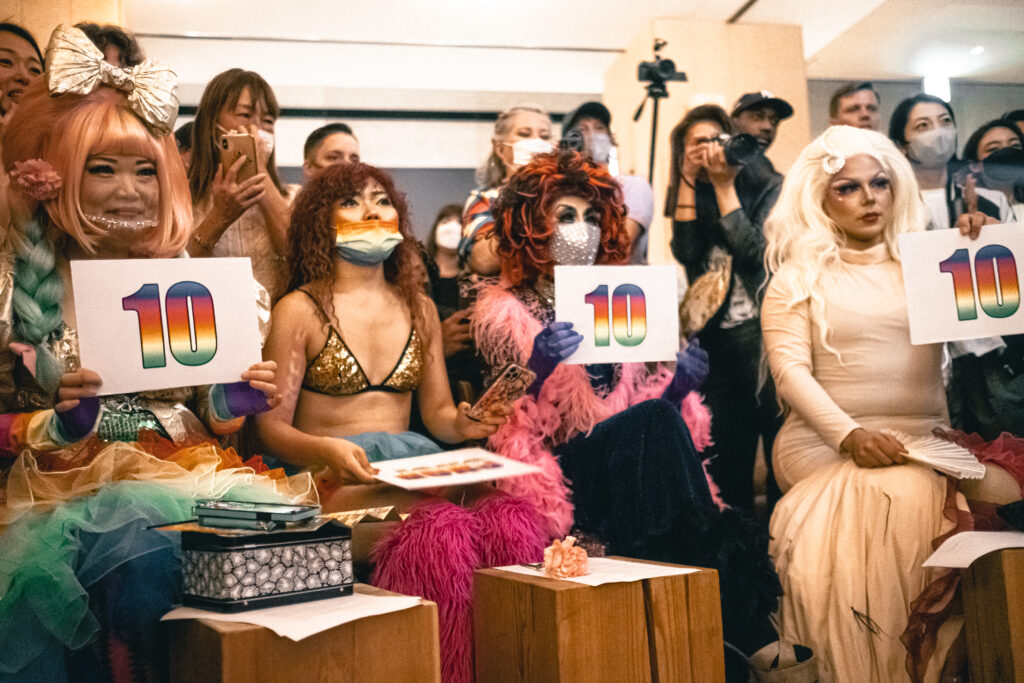
When a given category like, say, Vogue Femme Performance, begins, the first round is called tens: a preliminary level to check participants have the fundamental skills and are following the dress code theme, when applicable. Competitors gather at the bottom of the T-shaped runway, far away from the judges, and each enter one-by-one, giving a solo show for the crowd and finishing up directly in front of the judges, who raise hands or flags to indicate “I give my tens.” All judges must give tens for the competitor to pass this preliminary level; a chop motion signals ‘not today.’
Once all the competitors have entered and received their tens or chop, the category closes and the battle begins: participants are paired off and re-enter the runway together, battling it out for several minutes until the commentator calls time and the judges vote on their favorite. This continues until a single winner remains to seize the trophy.
Significantly, a rule within ballroom stipulates that members of the same house do not have to battle one another. This means during, say, a kiki ball, a single member of the Kiki House of Versace may be facing a gauntlet of five or more from the Kiki House of Pinklady—the Versace will have to battle and defeat every single Pinklady in succession if they want to win! Alternatively, multiple members of Pinklady may jointly take the trophy if the Versace is eliminated. The clashing of houses is an especially exciting part of ballroom battles!
Classic Categories
There are dozens of different categories through which the various balls and functions circulate, especially on the kiki level where there is more room for ball hosts to become creative with something new. Certain categories, however, you will almost always see at every ball, especially here in Japan: Realness, Face, Runway, and Vogue (dance). Other popular categories include Body, Fashion/Dress, and Sex Siren.
Realness: If houses are the soul of ballroom, then realness is the heart. Something of a ‘museum category’ of ballroom, as I like to think of it, realness has remained unchanged since the founding days of ballroom in the 1970s. Realness celebrates the survivalism of transgender and gay people, past and present: the work they go through not to be identified (or “clocked”) as a marginalized identity and to pass in mainstream society.
Realness has come under criticism in modern queer discourse, where the focus has shifted to LGBTQ people not needing to pass, or to expressing their identities in open rebellion against the norm. At the same time, many realness walkers feel the category acknowledges the struggles many of us continue to face navigating and finding employment and housing in the wider world. It is also an important snapshot into the lives and resourcefulness of Black and Latinx queer pioneers of the 1970s.
The most commonly used categories are Femme Queen Realness, Trans Man Realness, Butch Queen Realness, Butch Queen up in Drag Realness, and Butch Realness.
Face: A standard beauty contest where contestants’ bone structure, straightness and whiteness of teeth, and clear skin is judged.
Runway: Usually broken into two distinct styles, European (exaggerated, feminine-style) and All American (boxy, masculine-style), runway asks judges to evaluate competitors based on the skill of their runway walk and their fashion sense.
Vogue: The dance-off categories have become some of the most famous in house-ballroom thanks to reality TV shows including Legendary. The main styles of ballroom dance include Old Way, New Way, and Vogue Femme. Old Way was the original style of vogue, pioneered in the 1970s by Paris Dupree and featuring pops, dips, and spins; the movements are often angular and take cues from fashion poses in magazines and martial arts. New Way evolved from Old Way in the 80s or 90s is based on the elements of arms control, posing, and stretching, and performances resemble contortionism and gymnastics with clean lines. Vogue Femme is the most recent and popular form of vogue, emerging around 1992 as an exaggerated portrayal of trans women (femme queens) performing Old Way in a soft and feminine style. It famously revolves around five elements: catwalk, duckwalk, hands, floor performance, and dips (inaccurately called “death drops” on RuPaul’s Drag Race), as well as, unofficially, hair choreography such as hair whips and flips. Balls also feature other vogue subcategories like hands performance and arms control, which spotlight specific techniques within the wider vogue schools.
Body: Another classic beauty pageant category, here competitors show off their physique, competing in subcategories of body type such as model-thin, muscular, luscious (full and curvy), and big boy and big girl.
Fashion and Dress: These are entirely costume-focused categories, the most common of which is Best Dressed. At the time of ballroom’s inception in the 1970s, Best Dressed asked its competitors to wear their best church-going attire; today, the prompt is often ‘red carpet formalwear.’ Fashion Killa, closely related, asks for fashionable streetwear, while Bizarre requires a costume so strange, elaborate, and alien that the competitor ceases to look human.
Sex Siren: Added to ballroom in 1995 by Jack Gorgeous Gucci, Sex Siren celebrates the artistry of the transgender women who turn to sex work to survive. Music and lighting for this category is turned low and atmospheric, and contestants approach and attempt to seduce and impress the judges with their sex appeal. Photos and videos from the audience are not allowed during Sex Siren, and contestants’ sense of safety is prioritized (for example, if a contestant asks, “I want all cisgender heterosexual men to leave the room before I walk,” this would be respected).
The Gender and Gender-Expression System of Ballroom
Ballroom also carries a system of gender identities and gender expression-based classifications, reflecting both its 50-year history and the understanding of its pioneers, as well as the unique micro-cultures (such as what it means to identify as a Femme Queen) that have developed within its walls. Categories are also often broken up into gender or gender-expression based subgroups during a ball, so I would recommend that prospective competitors learn the system and figure out where they fall in it.
Femme Queen (FQ): The first and most celebrated identity within ballroom, femme queens are a subculture of transgender women who express hyper femininity within the label. Much like the wider LGBTQ rights movement, ballroom has always been led by and built upon the backs of Black and Latinx femme queen mothers like Crystal and Lottie LaBeija.
Women: Within ballroom terminology, categories for “women” refer specifically to cisgender women, both gay and straight. Cisgender heterosexual women began appearing in balls as allies of the LGBTQ in the 1980s and have always had a much stronger presence than their cishet male counterparts, earning the community’s trust and acceptance. Cisgender women and femme queens have competed in distinct gender categories since these early days, in part because it reflected the understanding of sex and gender of the queer community in this era, and in part to further spotlight and honor the femme queens—a femme queen will always hold a trophy if there is a specific “FQ” subcategory.
Butch Queen (BQ): The ballroom term for a queer man (gay, bisexual, or pansexual), as well as some assigned-male-at-birth nonbinary individuals who identify as butch queens.
Butch Queen Up in Drags (also just called “Drags,” or shortened to BQUID): Essentially a Butch Queen (that is, a queer man or AMAB nonbinary) presenting themselves as a woman, with hip pads, dress, nails, wig or long hair, and make-up. Ballroom drags shares a common origin with the well known drag show queens who perform in nightclubs, but in the present era, Drags has evolved to emphasize smaller, more natural, everyday woman-aesthetics and glamor than its outrageous show queen counterpart.

On a historical note, BQUID often served, in the past, as a category for ‘femme queens in training’: individuals questioning their gender, who wanted an opportunity to practice dressing as and presenting as a woman, sharpen their skills, and see if this was the gender with which they resonated.
The category is open, however, to both these questioning individuals and to butch queens who simply enjoy hyper feminine presentation.
Butch: Butch lesbians, sapphics, and assigned-female-at-birth nonbinary individuals who identify as butch.
Butch, particularly categories such as Butch Realness, can be understood as the AFAB counterpart to BQUID: queer women and nonbinaries who present themselves as men, often with chest binders, short or concealed hair, and clean faces. Also like BQUID, Butch has often served as a training ground for prospective trans men looking to explore that side of their identity.
Trans Man (TM): Trans man categories may also include trans-masculine nonbinary individuals who self-identify as trans men.
Twister: Butch Queens who walk the Butch Queen Realness category (i.e. where they present as masculine and straight-passing), but who also vogue femme. Because BQ Realness reflects those who live a consistent, masculine lifestyle, Twister gives the BQ Realness walkers special permission to unlock their feminine energy on the dance floor.
Male Figure (MF): This broadly groups all masculine presentations, including butch queen, butch, trans man, twister, and any cishet men looking to compete. A MF subcategory (such as MF Vogue Femme or MF Body) is often a simpler designation for ball organizers.
Female Figure (FF): Much like Male Figure, this groups all feminine presentations, including femme queen, (cis)women, and butch queen up in drags under a single banner.
Gender Nonconforming (GNC): A somewhat controversial new gender expression category which kiki icon Symba McQueen began in 2015, and Rikka Milan and India 007 started in the major scene in 2022. GNC welcomes competitors of any gender who can present a mix of masculine and feminine style in their clothing fashion.
Open To All (OTA): A category that is OTA welcomes any and everyone.
Final Advice
As always, my biggest advice for people entering a marginalized community for the first time (be it ballroom or Shinjuku Ni-chome) is to hold the appropriate attitude: to be open-minded, respectful, and observant, and also to educate yourself on the history and values of the space beforehand and after.
Some of the best resources for deepening your understanding of ballroom lie less in popular media depictions like Pose, and more in real life voguing classes, practices, and casual ballroom functions which crop-up every month. At these events, people bond, share cultural knowledge, and practice for different categories. Information on these classes and practices can be found on the Ballroom Japan Instagram page. Always, never shy away from reaching out to an experienced mentor with questions
My last advice would be to find a balance between competitiveness and easygoing fun. The heat of a battle can bring out the best in our abilities and push us to take risks; it is also important to remember, however, that this is a gathering based on queer joy.
Ballroom can be an intensely lively and creative space. Here, I’ve made friends and found-family members with whom I can hold deep, introspective conversations for hours, dance in the streets all night, and share my happiness and troubles. Congratulations to everyone just beginning their ballroom journey!







No Comments yet!