Human nature is indomitable. As pilgrimages were in the past something that reinforced our relationship with the most mundane aspects of the divine, now, in more secularized times, other kinds of pilgrims roam in wanderlust, inspired, perhaps, by the same spiritual desires that once led our ancestors to embark on their journeys. In the pursuit of reliving our favorite books, animated works, or feature films, we chase that connection to works that inspire us, attempting to recreate the worlds our fantasies are made of.

In Japanese literature, few novellas hold a place of honor quite like Yasunari Kawabata‘s The Izu Dancer (Izu no Odoriko 伊豆の踊り子). Published in 1926, this semi-autobiographical short story isn’t particularly flashy; there’s no grand plot twist or dramatic finale. Instead, its quiet power lies in subtle emotional shifts, gentle interactions, and the vivid portrait it paints of the Izu Peninsula. For Nobel Prize-winning Kawabata, Izu served as an essential part of the story’s soul, shaping the novella’s tone and emotional depth.
Nearly a century after publication, the symbiosis between Kawabata and Izu remains strong. Literary pilgrims still retrace the novella’s route, wandering through lush forests, old tunnels, and quiet hot-spring villages in search of its timeless essence. And remarkably, Kawabata’s writing has left tangible marks on Izu itself. Bronze statues of the young protagonists, along with various monuments, can be found along the Odoriko Trail — the same path that the protagonists traveled, hence the name — and countless signboards and souvenir shops in the area highlight the literary connections of the region.
Entering Kawabata’s Izu
Arriving in Izu feels instantly different. The pace slows, the air freshens, and mountains rise around you like a quiet welcome. Kawabata himself once confessed that his first journey here, at the age of 20, was driven by a desperate need to escape the suffocating gloom of his orphaned youth. He found solace in the peninsula’s winding paths, mist-covered mountains, and soothing rivers, landscapes he would later immortalize in The Izu Dancer.

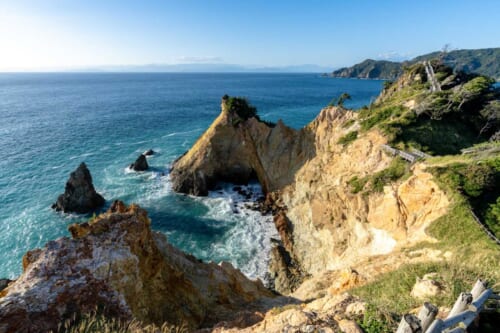
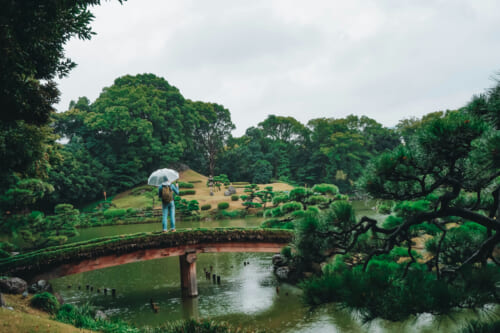
Maybe it’s my wishful thinking at play here, but the lush and mostly untouched greenery of Izu made me wonder that, perhaps, what I’m seeing today is not so different from the landscapes that struck Kawabata.
In the novella, the protagonist’s loneliness gradually dissolves into gentle curiosity as he journeys through Izu, aided by the excitement of his encounter. Kawabata captures this emotional landscape effortlessly: his characters rarely speak their feelings explicitly, yet their surroundings — the dense cedar forests, cool mountain air, and sudden downpours — quietly echo their inner transformations.
Some Practical Notes
For those willing to undertake the complete Odoriko Trail, be prepared for a roughly 19-kilometer walk through uneven terrain and mountain paths. The full trail follows the old Shimoda Highway, beginning near Joren Falls and crossing Amagi Pass before descending alongside the Kawazu River toward the coast. It’s not a difficult hike, but it does require time, good footwear, and a bit of planning.
For convenience, the Tokai Bus Free Pass 伊豆箱根バスフリーパス is a solid investment. It allows unlimited hop-on, hop-off access on buses between Shuzenji, Amagi, Kawazu, and Shimoda for two or three days. It’s especially useful if you’re not walking the entire trail or want to split the journey across two days without being stranded by infrequent rural bus schedules. I used the two-day pass.
Most travelers start the trip from Shuzenji, which is accessible by train via the Izuhakone Sunzu Line from Mishima. From there, buses take you to Joren Falls or onward to trail access points and cultural sites tied to the novella.
Into the Mountains: Joren Falls and Showa no Mori
After an approximate 40-minute bus ride, my first stop begins deep in the interior of Izu with the quiet insistence of running water. Joren Falls 浄蓮の滝 is one of those places that would have caught Kawabata’s attention without asking for it. You reach it after descending into a deep valley, and the surrounding forest is thick, damp, and unpolished. Water tumbles from the rock face in a single, insistent column, feeding the wasabi fields that spread out below.
The mountain road, stitched on one side with whitewashed pickets, coursed down from the mouth of the tunnel like a jagged lightning bolt.
 Joren Falls
ESTABLISHMENT POINT_OF_INTEREST TOURIST_ATTRACTION- 892-14 Yugashima, Izu, Shizuoka 410-3206, Japan
- ★★★★☆
Nearby, the Showa no Mori Kaikan 昭和の森会館 is an optional spot that I suggest for a subtle shift to a more cinematic tone. Inside, character photos and production stills document how The Izu Dancer has been adapted for the silver screen over and over again. I haven’t seen any adaptation, but I took an interest in seeing how this story has resonated with audiences throughout the decades, and having a small insight into what each portrayal looked like was a nice touch.
- Showa no Mori Kaikan
ESTABLISHMENT MUSEUM POINT_OF_INTEREST - 892-6 Yugashima, Izu, Shizuoka 410-3206, Japan
- ★★★☆☆

Crossing the Threshold: Amagi Tunnel and the Long Descent
If there’s one location where Kawabata’s fiction and Izu’s physical geography converge most clearly, it’s the old Amagi Pass Tunnel 旧天城トンネル. In the novella, the student and the troupe ascend toward the pass under a curtain of rain. The stone tunnel is a little narrow and only sufficiently lit to ward off hesitation. It’s also a very significant landmark that acts like a threshold, where the protagonist is still a solitary youth, unsure of how to engage with the world. After crossing, he catches up with the dancing troupe and begins to open tentatively to companionship, to emotion, and to the idea that kindness might not be a performance.
“Surely I could catch up with them along the fifteen miles of mountain road over Amagi.” Thus I had been daydreaming as I hastened along the road that day.
- Old Amagi Tunnel North Side
ESTABLISHMENT POINT_OF_INTEREST TOURIST_ATTRACTION - Yugashima, Izu, Shizuoka 410-3206, Japan
- ★★★★☆
Walking the same route today, that shift still resonates. The old tunnel is intact, mossy, and dark even on a bright day. The air turns damp, footsteps echo against the stone, mobile signal fades into oblivion, and you emerge blinking into sunlight.
On the road down to the next bus stop, the modern route curves gently along the mountain. Not far from it, the Nikai Waterfall 二階滝 appears discreetly. It’s modest in scale but beautiful in that same fleeting, unadorned way that characterizes Kawabata’s prose.
- Nikai Waterfall
ESTABLISHMENT POINT_OF_INTEREST TOURIST_ATTRACTION - Nashimoto, Kawazu, Kamo District, Shizuoka 413-0501, Japan
- ★★★☆☆
Down to the Coast, Kawazu and Shimoda at Dusk
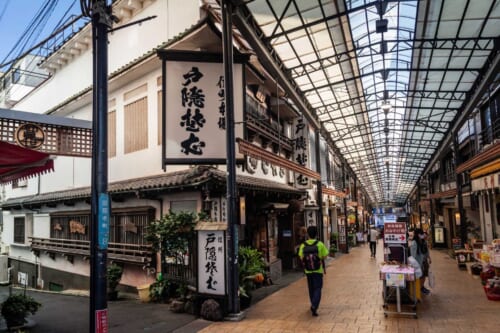
By the time you reach Kawazu 河津町, the mountains begin to relax their grip. The train station plaza features a bronze statue of the two protagonists, reinforcing how deeply The Izu Dancer has shaped the town’s image. From here, most visitors head straight to the waterfalls. But it’s worth lingering in town, even briefly, to notice how the novella’s presence slips into the details: signs, maps, souvenirs, even the name of the local onsen.
“Well, well. As the old saying goes, ‘On the road,a traveling companion; and in the world, kindness.’ Even boring people like us will help you pass the time. Come on in and take a rest.”
- Kawazu
LOCALITY POLITICAL - Kawazu, Kamo District, Shizuoka, Japan
- ☆☆☆☆☆
Further south, Shimoda is where the protagonists end their journey. Kawabata doesn’t dwell long on the town in the novella, but arriving near sunset feels right. Perry Road ペリーロード, with its canal-side lanterns and weathered facades, carries a sense of time both passing and suspended. The sea air is heavier here, the mood slightly more wistful.
- Shimoda
LOCALITY POLITICAL - Shimoda, Shizuoka, Japan
- ☆☆☆☆☆
Spending the night in a ryokan, wrapped in a cotton yukata and listening to the quiet creak of old floors, brings you closer to Kawabata’s world than any monument could.
Morning Light, Kawazu River, Odoriko Onsen, and Yugano
The next morning, Kawazu feels like a different place. Walking upriver, even outside sakura season, the path is quiet and slow-moving, echoing the novella’s mood as the journey winds down. There’s a small day-use hot spring here called Odoriko Onsen Kaikan 踊り子温泉会館. Only the name ties it to the story, but it’s a worthwhile stop if you’re not booking a stay at an onsen ryokan.
Just outside Yugano we found ourselves again in the mountains. The sun hanging over the sea warmed the slopes. We gazed toward the morning sun. Kawazu Beach spread wide in the sunlight out where the Kawazu River flowed.
- 踊り子温泉会館
ESTABLISHMENT POINT_OF_INTEREST - 457-1 Mine, Kawazu, Kamo District, Shizuoka 413-0511, Japan
- ★★★☆☆
Further along Kawazu River, Yugano Onsen 湯ケ野温泉 is where fiction and memory begin to blur. This was the setting for several film adaptations, and it’s also where Kawabata stayed during his original 1918 journey. The ryokan Fukudaya 福田家 still stands by the river, its wooden structure preserved, a bronze statue of the dancing girl on one side and Kawabata’s engraved lines on the other. You can’t go inside without a reservation, but standing there, it doesn’t feel necessary.
- Yugano Onsen
ESTABLISHMENT POINT_OF_INTEREST SPA - 128-1 Yugano, Kawazu, Kamo District, Shizuoka 413-0507, Japan
- ★★★★☆
- 伊豆の踊子の宿 福田家
ESTABLISHMENT LODGING POINT_OF_INTEREST - 236 Yugano, Kawazu, Kamo District, Shizuoka 413-0507, Japan
- ★★★★☆
Kawazu Nanadaru and the Quiet Farewell
The Kawazu Seven Waterfalls 河津七滝 aren’t meant to be rushed. Scattered along a shaded ravine, this is one of the prettiest settings for a relaxed, leisurely walk. A bronze sculpture near one of the larger falls, titled Odoriko to Watashi (The Dancing Girl and I), captures the feeling with surprising precision. The two figures sit side by side, not touching, framed by the water. There’s no drama in their posture. Just stillness.
Twenty years old, I had embarked on this trip to Izu heavy with resentment that my personality had been permanently warped by my orphan’s complex and that I would never be able to overcome a stifling melancholy.
- Kawazu Seven Waterfalls
ESTABLISHMENT POINT_OF_INTEREST TOURIST_ATTRACTION - Nashimoto, Kawazu, Kamo District, Shizuoka 413-0501, Japan
- ★★★★☆
By this point in the journey, the narrative has thinned to suggestion. Kawabata doesn’t spell out what the student feels, only that something inside him has shifted, and that the trip has given him a kind of gentle clarity. The story doesn’t end with an arrival. It ends with parting, quiet and necessary.
A journey through Izu doesn’t require having read The Izu Dancer, but there’s a lot to be gained if you have. Places that might otherwise feel incidental, like a tunnel, a trail, or a small-town train station, begin to carry emotional weight. Kawabata never asked readers to marvel at landscapes; he simply placed his characters inside them, letting the natural world do what it does best: soften, reveal, and quietly unsettle.
Nearly a century later, the relationship between Izu and the novella remains surprisingly intact. Kawabata was changed forever by Izu, and in turn, Izu has been forever marked by Kawabata. Statues and plaques mark the path, although the deeper connection lies in the atmosphere. It’s in the sound of water after a long walk. It’s in the ordinariness of a moment that suddenly feels like it matters. It’s about allowing stillness. About reading a landscape the same way he wrote people: delicately, with space for things left unsaid.
Note: All quotations from The Izu Dancer are taken from the 1997 English translation by J. Martin Holman, published by Counterpoint Press.








No Comments yet!