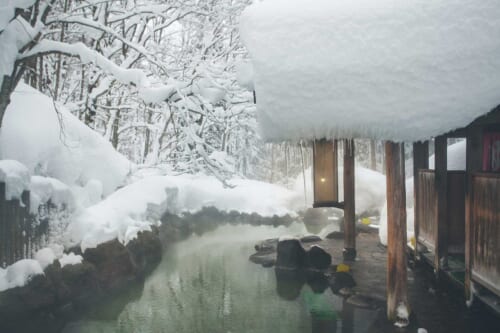
Akita Prefecture, located in northern Honshu, Japan, is known for its dramatic, snowy landscapes, hot springs and crystal-clean sake due to its vast supply of pure water. It is also known as a culinary hotspot with dishes including kiritanpo being widely recognized as a regional classic. Art, however, also plays a central role in this prefecture with several large-scale museums and galleries being located there. One of Japan’s leading artists of the 20th century, Léonard Foujita (born Tsuguharu Foujita), also has a special place in the hearts of art lovers in Akita due to a large collection of his work being hosted at the Masakichi Hirano Art Foundation.

Foujita, it could be said, led an eventful life. Born and raised in Tokyo, he moved to Paris and became part of the années folles in the French capital, befriending other artists including Picasso, Modigliani, and Diego Rivera. With a distinctive look, a rigid and sharp moustache, round spectacles and flamboyant but dapper fashion he became known as a socialite, artist, bon vivant, and womanizer (he married five times). In addition to being a long-term resident of Paris, he also spent a significant period of his life traveling the world with stints in Mexico, the US, South America, and London.

Later in life he converted to Catholicism and his work, naturally, became more religious in tone. Similar to his compatriot, the novelist Shusaku Endo, Foujita immersed himself in the Catholic faith and even designed a church named Chapel of Our Lady of Peace which was to be his final work before his death in 1968.
Known for his blend of Western and Japanese-style painting, Foujita has been seen as an artistic and aesthetic bridge between two cultures. He created one of his most ambitious works in Japan, titled The Events of Akita (Akita no Gyoji), a monumental mural which was completed in 1937. The museum, designed by globally acclaimed architect Tadao Ando, highlights the mural as its signature masterpiece, underscoring its central role in the region’s cultural identity.
The impressive scale of the work immediately commands visitors’ attention. Measuring 3.65 meters in height and stretching an extraordinary 20.5 meters in length, it’s among the largest paintings Foujita ever produced. The vast surface allowed him to construct a sweeping panorama of Akita life, moving effortlessly through the seasons and capturing the natural rhythm of a year in the northern prefecture.
The visual narrative in summer begins with a burst of energy in depictions of lively local festivals, in particular the Akita Kanto Festival. Here, men balance towering bamboo poles strung with glowing lanterns, an example of skill and spectacle that has become one of the city’s defining traditions, while winter closes the cycle with a coda of snow-covered landscapes. Children playing in the snow, villagers bundled against the cold, and scenes of seasonal customs evoking both hardship and joy.
Stylistically, The Events of Akita exemplifies Foujita’s distinctive fusion of East and West. His powerful linework, attention to seasonal leitmotifs, and allegiance to local details reflect an inherent Japanese sensibility. At the same time, the composition reveals his European training — Renaissance-inspired structure, construction of perspective, and monumental scale. His use of earthy hues and luminous whites, hallmarks of his style, adds both harmony and solemnity, balancing intimacy with a certain Western pomp and greatness.
The mural is more than a technical achievement; it is also a work of cultural and personal significance. Having spent much of his career in Paris, Foujita aimed, in the 1930s, to reestablish his links with Japan. By celebrating Akita’s traditions, he not only honored regional life but also responded to the growing emphasis on local culture, something that was popular in that particular era. Today, the mural stands as a masterpiece of contemporary Japanese art, a subtle marriage of Western technique and Japanese subject matter, and a vibrant tribute to the enduring spirit and anima of Akita.

Foujita has become an icon in Japan and overseas, with major exhibitions of his work being shown all over the world. A 2015 film, Foujita, starring Japanese movie star Joe Odagiri in the titular role, was a domestic and international hit that has carried on the artist’s legacy to this day. There is an intrinsic bond between Foujita and Akita that has continued into the 21st century, his works imbued with a contemporary vigor and vitality.
The seasonal activities shown in Foujita’s legendary mural also live on in the prefecture, an area of Japan which holds tradition and memory close to its heart. The people, history, and pride of Akita can be seen and appreciated in Foujita’s The Events of Akita, but also in the streets and towns of one of Japan’s most underrated prefectures.
 Akita Museum of Art
ESTABLISHMENT MUSEUM POINT_OF_INTEREST- 1-chōme-4-2 Nakadōri, Akita, 010-0001, Japan
- ★★★★☆
Sponsored by Akita.






No Comments yet!