Japan is full of places described as “hidden gems,” “undiscovered treasures,” or “unexplored wonders.” Most of the time, however, it’s little more than a marketing sleight of hand meant to coax travelers beyond Tokyo and Kyoto and their own comfort zones. In an age of over-tourism, this kind of exaggeration can even feel well-intentioned, though it does tend to stretch the meaning of “hidden” until it loses almost all of its original meaning.
And yet, genuinely quiet, almost secret places do still exist throughout Japan. Tucked into southern Yokohama is one of them: Hongofujiyama Park and its vast bamboo forest. It’s a place that doesn’t advertise itself and rarely appears on social media or in guidebooks, almost like it doesn’t care whether people know about it. That’s one of the reasons why it feels so special.
Hongofujiyama as a Bamboo Hub
The bamboo grove is the heart of Hongofujiyama. Spreading across roughly 2.5 hectares, it’s one of the largest bamboo landscapes in all of Yokohama, dominated by towering moso bamboo that rises straight and impossibly tall toward the sky. In atmosphere, it genuinely rivals Kyoto’s famous Arashiyama forest, only without the crowds, selfie sticks, or people carving their names onto the trees. The bamboo here also feels less curated and more alive as part of a working satoyama site of people living harmoniously with nature without bending it to humanity’s will.
It’s easy to find the words to describe Hongofujiyama’s bamboo but unless you’ve actually walked between these towering green pillars, you’ll never know the singular feeling of disappearing into the heart of nature a stone’s throw away from the hustle and bustle of civilization. Hongofujiyama Park sits near Yokohama’s border with Kamakura, wedged between quiet residential neighborhoods and two relatively minor stations on the Negishi Line: Hongodai and Konandai. From Hongodai Station, it’s about a 15-20-minute walk; longer if it’s your first visit and you’re stopping every few minutes to wonder: “Am I actually going the right way?”

The way leading towards the park branches off a busy road and narrows into a residential lane with almost no signage, threading between private homes, parked bicycles, and laundry swaying in the breeze. Then, almost abruptly, you see it: bamboo rising above a stone wall, marking a clear boundary between everyday suburbia and something older, quieter, and wilder. Go further and the shift is immediate. One moment you’re passing family homes, the next, you’re inside a 9-hectare park that feels like a preserved fragment of pre-modern Japan.
Hongofujiyama’s History
Opened in 2000, Hongofujiyama Park isn’t a manicured city park so much as a living cultural landscape. Rising to roughly 80 meters at its peak, it preserves an entire hillside of forests, agricultural plots, and historic structures, all a relatively short stroll from a bunch of convenience stores and restaurants. On clear days, parts of the ridge even offer distant views of Mount Fuji, a quiet reminder of why this area carries the name “Fujiyama.”
At the center of the park stands the reconstructed Koiwai family residence, an Edo-period (1603 – 1868) farmhouse originally built in 1847. Designated a Yokohama City Tangible Cultural Property, the house features a thatched roof, massive support pillars, hearths, and even a reconstructed fireproof storehouse. During local events, it becomes a stage for storytelling sessions, rituals, and workshops that transport visitors to feudal Japan.
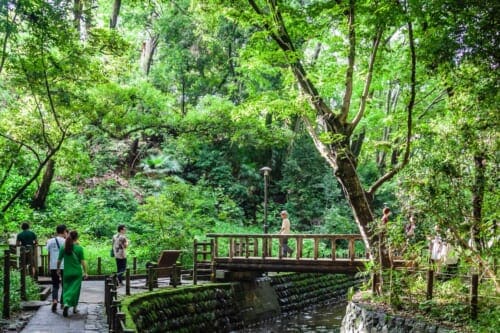
Around it, the park unfolds into a surprisingly rich assortment of facilities, zones, farm areas, and even a kyudo (Japanese archery) hall. Still, it’s the bamboo that leaves the deepest impression. The main bamboo routes pull visitors deep into the forest. The paths are protected and clearly defined, often steep, and unfortunately not wheelchair accessible. However, while the city and volunteers maintain the grove with care, it retains a sort of untamed, magical quality. In winter, when surrounding trees fade to browns and grays, the grove remains vividly green, creating a striking contrast that more photographers should be obsessing over.
Passing collapsed trees, exposed soil held together by bamboo roots, and light filtering down in shifting beams of sunlight through the green canopy above is like walking meditation, which is only occasionally disrupted by a zooming squirrel. Hongofujiyama’s bamboo forest is home to a healthy population of squirrels, which frequently dart across paths or leap between stalks like tiny, furry ninjas. Often, you’ll hear them before you see them, adding to the sense that the forest is paying attention to you as you pay attention to it. The effect can at times be a little eerie, especially when you find yourself completely alone in this sea of trees.
In more than 20 years of hiking here (which can take anywhere from 20 minutes to well over an hour depending on how much wandering you do), I can’t recall ever encountering more than a handful of people at once. I think the most was five, but we were all pretty spread out. The park does draw larger crowds during festivals, mochi-pounding events, moon-viewing nights, or seasonal celebrations, but on an ordinary day it offers something increasingly rare in Japan: silence and real solitude in a place that could and by all right should be a major tourist draw.
The Ideal Urban Retreat
Hongofujiyama Park isn’t the easiest place to reach and walking its undulating paths is undeniably a workout and a half. But it’s more than worth it as it rewards you with mossy trails, soft light filtered by the tops of bamboo trees, green fingers of nature stretching skyward, and the strange comfort of forgetting, if only for a short while, that you are surrounded by Japan’s second biggest city.
If you ever find yourself in Yokohama with a bit of time and a willingness to become slightly lost in your surroundings, Hongofujiyama will be waiting there for you, quietly reminding travelers what a true hidden gem feels like.
 Hongofujiyama Park
ESTABLISHMENT PARK POINT_OF_INTEREST- Japan, 〒247-0009 Kanagawa, 横浜市栄区Sakae Ward, Nakanochō, 20, 鍛冶ヶ谷1丁目20番
- ★★★☆☆






No Comments yet!