What does a stay at a traditional Japanese inn look like when your travel companion has four legs and a tail? We give you an inside look at our relaxing stay at a pet-friendly hotel in Izu.
What’s a Ryokan, and Why No Pets?
A ryokan is a traditional Japanese inn, best known for tatami-matted rooms, seasonal multi-course meals, and hot spring baths. With futons, yukata, and the faint mineral scent of natural hot springs, a ryokan stay is a must-try experience for curious travelers in Japan. Even those searching for pet-friendly hotels that offer a more authentic experience.

For a long time, though, pets simply didn’t fit into that picture. Tatami floors are delicate, shared spaces demand careful hygiene, and the calm, orderly atmosphere that ryokan strive to maintain leaves little room for unpredictability. Therefore, many inns adopted strict no-pet policies, not out of unkindness, but to protect both the physical space and the experience they were built to offer.
The Rise of Pet-Friendly Ryokan
In recent years, that long-standing boundary has begun to soften. As pets increasingly travel with their owners and are treated as full-fledged family members, some ryokan have started reimagining how tradition and contemporary lifestyles can coexist.
Rather than simply “allowing” pets, these newer pet-friendly hotels design their spaces with furry companions in mind. Hot spring destinations like Izu have been at the forefront of this shift, offering stays that preserve the spirit of ryokan culture while making room for wagging tails and soft paws.
Curious to see how this new approach worked in practice, we headed to the Izu Peninsula with our toy poodle, Alice, and checked into Point Vacation Nishiizu ANNEX.
 Point Vacation Nishiizu ANNEX (Yururi Nishi-Izu)
ESTABLISHMENT- 349-2 Toi, Izu, Shizuoka 410-3302, Japan
- ★★★★☆
Checking In
By the time we arrived, the day had softened into that gentle coastal evening light Izu does so well. Our furry friend Alice, who had accompanied us through hours tracing rugged shorelines and winding mountain roads, was clearly ready to rest. We were too.
That sense of ease settled in almost immediately. A kind host greeted us at the entrance, and instead of the formal hush we half-expected, the lobby felt relaxed and lived-in. Alice, of course, noticed the important things first: a free pet snack dispenser placed suspiciously at nose level, an indoor play area stocked with toys, and several other dogs lounging beside their owners. There was no awkwardness, just a quiet understanding that everyone here had chosen this place for the same furry reason.

Ryokan stays traditionally begin with slipping into a yukata, and here that ritual came with an unexpected twist. Alongside neatly arranged adult yukata was a rack of tiny ones made for pets. Watching Alice sit patiently in her miniature robe made us aware that we were all fully sharing the ryokan experience.
A Room Designed for Shared Comfort
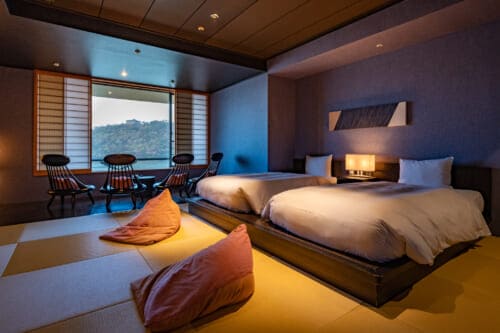
Our room continued that same thoughtful tone. Rather than any telltale signs of a “pet room,” we were met with a clean, carefully arranged space that felt unmistakably traditional in spirit. The faint aroma of cypress and drifting hot spring steam filled the air.
Alice was free to roam anywhere inside, even across the tatami mats, which were edged with paw-print patterned fuchi, a subtle yet memorable detail. A compact crate stood ready, stocked with toilet sheets, disposal bags, wipes, and neatly arranged bowls and plates.
Hot Springs
The hot springs themselves were a highlight. Soaking in the open-air bath, I gazed up at the night sky, dazzling and dense with stars, like the ceiling of a planetarium.
While pets aren’t permitted in bathing areas or communal hot springs, the staff had prepared a charming compromise. Set up in a common area was a miniature onsen-style corner just for dogs. It was undeniably cute, but also thoughtful, acknowledging that while certain traditions need boundaries, the shared spirit of travel doesn’t.
Dinner
As evening deepened, we changed into our yukata and headed to dinner. One of the most memorable aspects of the stay was that Alice joined us in the restaurant. She was offered a cushion, the option of an open crate, and a small assortment of pet snacks. Her presence was treated as entirely normal, which somehow made it feel all the more special.
Dinner unfolded in the familiar rhythm of a ryokan meal: a gentle procession of dishes highlighting local ingredients and the season. Vegetable stew, hot pan steak, stewed fish, an array of appetizers, drinks, and a delicate seasonal dessert arrived one by one. Being able to enjoy it all without worrying about leaving Alice alone in the room changed the mood completely. The meal felt slower and warmer.
Rest, Reflected in Sleep
Back in the room, both beds and a futon had been laid out: another quiet nod to flexibility. Alice was allowed on either, as long as her paws were washed and her body wiped down beforehand, a rule we followed happily. That night, Alice slept more deeply than we’d heard in ages, her soft snoring filling the space with an unexpected sense of peace.
Morning arrived gently. Alice trotted with us back to the restaurant, where a traditional Japanese breakfast awaited: grilled fish, rice, miso soup, and an assortment of side dishes. With Alice settled quietly nearby, we could take our time without the small sense of hurry that usually follows when traveling with a pet.
Planning Your Own Pet-Friendly Onsen Stay
For travelers hoping to experience Japan’s onsen culture without leaving their pets behind, options like this are slowly but steadily growing. Beyond Point Vacation Nishiizu ANNEX, pet-friendly ryokan can be found in destinations such as Hakone, Karuizawa, and parts of Kyushu, many offering dedicated pet rooms, clear etiquette guidelines, and thoughtfully designed amenities.
Reservations may require advance notice, but what they offer in return is rare: the chance to experience one of Japan’s most cherished traditions as a shared journey. As pet-friendly hotels continue to evolve, they offer travelers a new kind of hospitality, for tired feet and paws alike.
Featured image by Alvan Nee




No Comments yet!