I have something of an epiphany when strolling through the beautiful Nara Park which is full of deer and incandescent autumnal colors. For many, Nara is simply a pleasant day trip from either Osaka or Kyoto. For the more savvy traveler, however, perhaps Nara should be your base location due to its undeniable beauty and relative peacefulness compared with its larger and more boisterous Kansai neighbors. Nara can be a much more affordable and agreeable destination in which to enjoy its astounding history and cultural heritage while taking advantage of its proximity to Kyoto and Osaka.
I happen to be in Nara to stay at the five-year-old JW Marriott Hotel Nara, one of the city’s more luxurious retreats and to see what the location has to offer visitors. One of the first things that hits you when you arrive in Nara is the tranquility. It’s much quieter than Kyoto. You can walk around without thousands of people being in your immediate vicinity. I visited during koyo (autumn leaves) which is probably the best time to visit as the city becomes illuminated in passionate hues of amber and orange. I walk from Shin-Omiya Station to JW Marriott Hotel Nara which takes about 10 minutes and as I arrive outside I notice that this hotel is really something else. The lobby is decked out with sophisticated Christmas decorations which emanates such a cozy and welcoming atmosphere.


As I sit in the The JW Marriott Hotel Nara’s very comfortable Executive Club with a newspaper and complementary drinks and snacks, before check-in, I look onto the quiet streets below and the brooding hills in the skyline and think about my day to come. I have a matcha tea ceremony experience before dinner at the hotel’s stunning Azekura teppanyaki restaurant and drinks at the Flying Stag. It’s going to be a long but really enjoyable day.
Matcha Tea Ceremony Experience
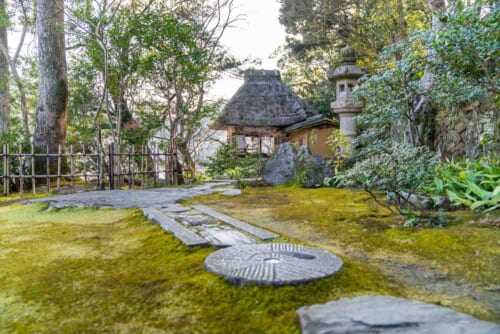
Mike Imai, clad in a beautiful blue kimono, ushers me into Nisimura-tei, a nearly 100-year-old tea house and explains a little bit of the history of the tea ceremony and the profound connection it has with Zen Buddhism. We start with some welcome drinks, a striking and translucent green tea the color of white wine and then a hojicha, brown tea with the hues of rose wine. We sample the delightful wagashi (traditional Japanese sweets) which are changed from season to season fitting with custom, and then Imai instructed me about the various bowing techniques used for both men and women. It’s all fascinating and this experience is well recommended. I ask Imai what the Japanese character swished in delicate yet powerful calligraphy on the wall means and he says, “mu” and goes on to explain that mu has a vital part to play in tea ceremony as it means beauty in imperfection and also emptiness. Creation and art come from emptiness and often the bowl we drink from in the tea ceremony shows characteristics of wabi-sabi or beautiful imperfection. It reminds me of my favorite fashion designer Comme des Garçons’ Rei Kawakubo who also uses the concept of mu as a starting point in creation. Imai is charming and supremely informative and I leave Nishimura-tei completely enlightened and eager to attend more tea ceremony experiences in the future.

Before returning to JW Marriott Hotel Nara for dinner I take a quick stroll through Nara Park before ending up at the city’s renowned Todai-ji Temple which is huge and genuinely beautiful. Deer crisscross through tourists and there is an air of optimism and joy in the air as I head towards the hotel for a feast for the belly and the eyes at Azekura, the hotel’s must-visit teppanyaki restaurant.
 Tōdai-ji
ESTABLISHMENT PLACE_OF_WORSHIP POINT_OF_INTEREST- 406-1 Zōshichō, Nara, 630-8587, Japan
- ★★★★☆
- Nara Park
ESTABLISHMENT PARK POINT_OF_INTEREST - Nara, Japan
- ★★★★☆
Azekura and the Flying Stag
Tenderloin steak prepared and cut in front of you by two chefs at the top of their game. Clean and seasonal vegetables, an array of salts and garnishes, champagne and a light, dry red wine all make for a fantastic night. It ‘s an intimate space where guests sit at the counter watching, at close hand, the chefs intricately cook and talk with patrons. We end the night with a delightful hojicha, milky cocktail in the neighboring Flying Stag bar which has a moody and impressive painting of the stag in question. Deer and stag play an important role in Nara where they were once positioned as gods and seen as more important than humans. They’ve been in Nara for millennia and it’s perhaps important to remember that we are in their land and not the other way around.
Leaving in Style
It’s a handsome hotel which has a huge and inviting pool, spa, and gym and the rooms, which are beautifully decorated and spacious, are replete with all mod cons that you would expect from such a luxury hotel. After dinner and drinks, I return to my room where I sit on the lavish sofa and turn off the lights and open the curtains to see the city in darkness with the odd sparkling light and the hills in the background, protective and all-seeing as I slip into bed and await for the next day to come and my breakfast at the fantastic Silk Road Dining restaurant where I help myself to an array of breakfast foods before jumping onto my Shinkansen to head home to Tokyo. Nara is a beautiful city with so much to offer and JW Marriott Hotel Nara is the ideal location to set up base for your Kansai adventures, an area of Japan deserving of your attention.

- JW Marriott Hotel Nara
ESTABLISHMENT LODGING POINT_OF_INTEREST - 1-chōme-1-1 Sanjōōji, Nara, 630-8013, Japan
- ★★★★☆






No Comments yet!