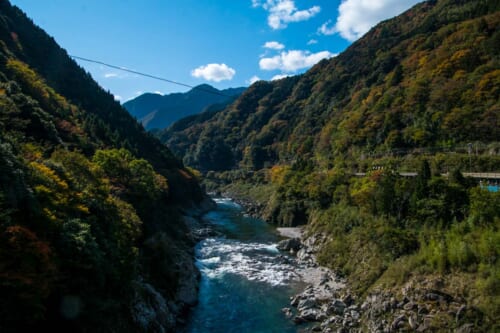
Iya Valley, with its vine bridges and thatched roof houses (especially celebrated Japanologist Alex Kerr’s Chiiori), is what brought me to Shikoku last summer. Little did I know, however, that Japan’s fourth largest island would also surprise me through its hiking paths.
In the Shade of the Lush Forest
I had one day left in Tokushima, and three potential hikes: Mount Ishizuchi, Mount Miune, and Mount Tsurugi. The first, Shikoku’s highest peak at 1,982 meters, seemed splendid but a bit steep — and a bit far as it’s located in Ehime Prefecture — so it ended up as a tie between Mount Miune and Mount Tsurugi. Both are rather close to each other, and equally appealing. Feeling only mildly adventurous, I thought the most popular hike would be Tsurugi, and that is how we arrived at the Minokoshi trailhead 見ノ越登山口 on a cloudy July morning.

The focal point of the Tsurugi Quasi-National Park, the so-called “sword mountain” 剣山, is 1,955 meters high, which makes it the second highest mountain in western Japan. Since the Minokoshi trailhead is already 1,420 meters high, it’s not a particularly challenging hike; and it is made even more accessible by an 830-meter long chairlift, bringing hikers 330 meters higher in just 15 minutes.

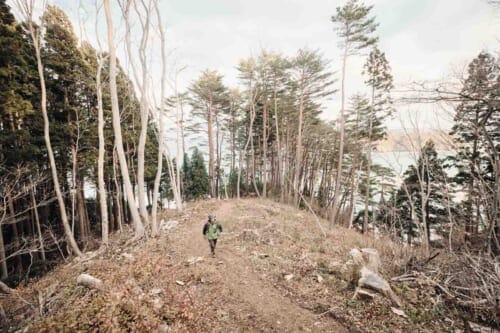
No chairlift for us, however. The path first weaves through a lush forest, and being surrounded by so much sasa bamboo reminds me that this is Japan (hiking in my native country rarely involves any type of bamboo) as it sometimes invades the path itself. On our walk we meet a few people on the way while hearing the chairlift in the distance. I like to think that the sounds of the machine keep the bears away, all the while knowing that there are next to no bears in Shikoku. According to the Nature Conservation Society of Japan, there are only 20 black bears left on the island (although they do actually inhabit the area around Mount Tsurugi), and their population is therefore considered endangered. There is more information on this topic at the shop close to the Minokoshi trailhead where you can also find a variety of mountain gear if you came unprepared.
A Shrine in the Clouds
The path clears and the trees become shorter as we arrive about halfway through the hike, where the chairlift lets go of its passengers. Soon, the greenery is replaced by a dry and rocky terrain as we reach Tsurugi Shrine 大劔神社, a rather atypical sight close to the precipice.
Mount Tsurugi happens to be an important focal point for Shugendo 修験道, a syncretic religion dating back to the 7th century, which draws on both Shintoism and Buddhism and places a particular emphasis on mountain worship.
 Tsurugi Shrine
ESTABLISHMENT PLACE_OF_WORSHIP POINT_OF_INTEREST- 201 Higashiiyasugeoi, Miyoshi, Tokushima 778-0201, Japan
- ★★★★☆
A sacred tower stone 御塔石 can be found on this particular mountain, representing the divine body of the shrine. It is said to forge the finest connections in this world, and it also makes for a popular photo spot. Beside the shrine, one can find “sacred divine water” 御神水 springing forth from the base of the stone.
(Almost) On Top of Shikoku
After a little pause observing the surroundings of the shrine, we climb higher. My favorite type of hiking takes place outside the forest — once the landscape reveals itself all around me, and rocky terrain prevails over sasa bamboo; when I feel that I have entered a different part of the world where no humans dwell. Yet, as we approach the summit, we do catch sight of temporary human dwellings, in the shape of a few colorful tents partially hidden among small trees. As remote as Iya Valley is, Mount Tsurugi does indeed appear to be a popular hike.
The sky becomes cloudier as we keep going, keeping us from fully appreciating the scenery, yet there is something mysterious and exciting about this evocative, moody atmosphere. Still, it’s slightly less exciting once, having reached the summit, the sky does not clear. But patience is eventually rewarded and once the clouds part, I can truly feel why Mount Tsurugi is ranked among Japan’s 100 Famous Mountains.
Back to Civilization
It soon becomes chilly at 1,955 meters, and we turn to stop at Tsurugi Chojo Hutte 剣頂上ヒュッテ on the way back. Warm food is being served inside as I have a look at the variety of products being sold, including local tenugui and mountain goods.
No hearty meal or night on the top of Shikoku for us, however, as it’s time to descend before the sun sets. There are several options for our descent, including one path weaving through still more greenery on the side of the mountain. Of course, it is also possible, and very tempting once the surroundings come into full view, to continue hiking on the mountain ridge, and reach Mount Jirogyu or Mount Miune.
We head back through the same path, and meet less and less people as the sky slowly darkens in the forest.
I wouldn’t have imagined that Shikoku could be a hiker’s paradise, and yet I now know that there is much to discover on the island’s heights without much need to fear meeting a bear. I could see myself coming back for more, sleeping on top of this gentle sword mountain before enjoying a sunrise hike on the ridge and discovering still more of Shikoku’s well-preserved secrets.
The only thing needed is a car, which applies to Shikoku in general, although there is a bus running from April to May and from July to November. It runs twice a day both to and from Mount Tsurugi, but mostly does so on weekends. Coincidentally, the chairlift closes during the winter season, from December to the end of April, when Mount Tsurugi’s sole travelers are the island’s few bears.
- Mount Tsurugi
ESTABLISHMENT NATURAL_FEATURE - Mount Tsurugi, Higashiiyasugeoi, Miyoshi, Tokushima 778-0201, Japan
- ★★★★☆




No Comments yet!